
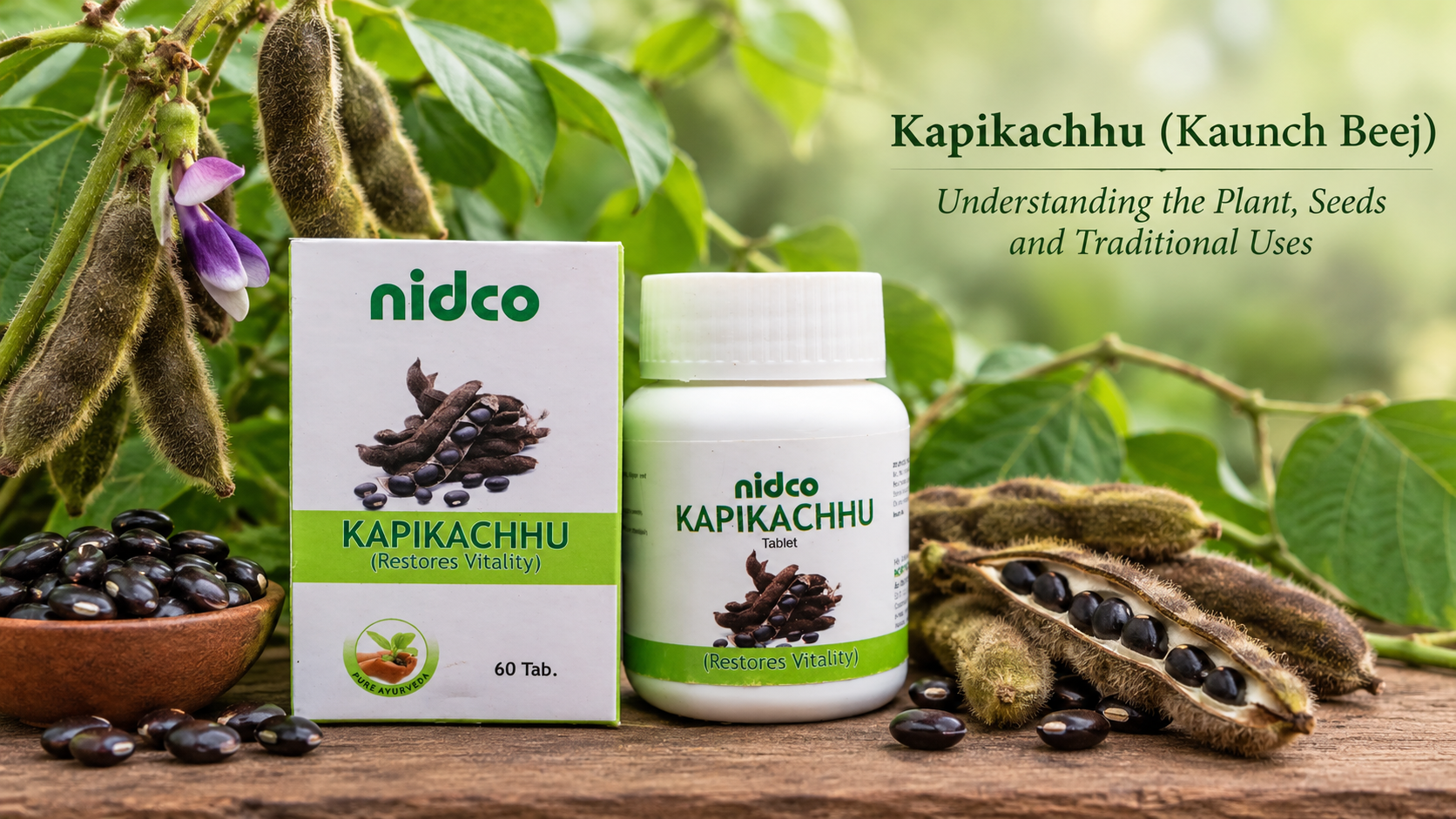
Kapikachhu, commonly known as Kaunch Beej, is a botanical ingredient associated with traditional Ayurvedic preparations. Kaunch Beej is scientifically identified as Mucuna pruriens, this climbing plant is also referred to as velvet bean and has attracted scientific interest because of its naturally occurring plant compounds.
But what exactly is Kapikachhu? How is it used in traditional Ayurveda, what makes its seeds scientifically interesting, and what should people know before considering a product containing this ingredient?
This guide explores its botanical identity, traditional context, scientific research, and important safety considerations.
What Is Kapikachhu?
Kapikachhu is a name associated with Mucuna pruriens, a climbing plant belonging to the legume family. Its seeds are commonly known as Kaunch Beej in India, while velvet bean is a widely used English name.
Different parts of the plant have different characteristics and compositions. The seeds are particularly notable because they naturally contain L-DOPA, a compound involved in dopamine production in the body.
The plant has a history of use in Ayurvedic medicine, and its chemical composition has attracted scientific interest. However, the properties of a botanical ingredient should not automatically be attributed to every preparation made from it.
Understanding Kaunch Beej and Its Composition
Kaunch Beej refers to the seeds of Mucuna pruriens. These seeds contain several naturally occurring compounds, including L-DOPA.
L-DOPA is converted into dopamine in the body. Dopamine is involved in several functions, including movement and aspects of motivation and reward.
This is an important distinction when understanding Kaunch Beej: the presence of a biologically active compound does not mean that every product containing the ingredient produces a particular health outcome.
The concentration of L-DOPA can vary with the plant material, processing methods, and preparation. Powder and extract formulations may also differ in composition.
For these reasons, the exact ingredients and specifications of an individual product matter when interpreting research about Mucuna pruriens.
What Are the Traditional Uses of Kapikachhu?
Kapikachhu (Mucuna pruriens) has an established place in traditional Ayurvedic herbal preparations, particularly those associated with reproductive health, vitality, and general nourishment. Its seeds have traditionally been included in formulations intended to support reproductive well-being and are discussed in Ayurvedic literature relating to Vajikarana, a branch of Ayurveda concerned with reproductive health and vitality. Traditional literature also describes its use in certain preparations associated with nervous-system and movement-related concerns.
One reason this plant has attracted interest beyond traditional medicine is its naturally occurring L-DOPA content. This compound is involved in dopamine production in the body, and researchers have investigated its potential relevance to neurological conditions. However, the presence of L-DOPA does not mean that every Kapikachhu preparation has the same effects or is suitable for treating a medical condition.
It is also important to recognize that traditional formulations can differ in their ingredients, preparation methods, and quantities. Therefore, the traditional uses described in Ayurvedic literature should not automatically be applied to every modern Kaunch Beej powder, extract, or tablet.
What Does Scientific Research Say About Mucuna Pruriens?
Scientific research has examined Mucuna pruriens, particularly because of the naturally occurring L-DOPA in its seeds.
Some clinical studies have investigated specific preparations in people with Parkinson’s disease. A systematic review of clinical trials published in 2025 identified five trials involving 108 participants. The researchers reported promising findings but emphasized that the available evidence remains limited and that further high-quality research is needed.
These findings should be interpreted carefully.
Research involving specific seed preparations, extracts, or doses does not establish the effectiveness of every commercial supplement. Differences in preparation, L-DOPA content, dosage, and study design can affect how results should be interpreted.
It would therefore be inappropriate to conclude that every Kaunch Beej product provides the same effects as a preparation investigated in a clinical study.
Scientific research helps us understand the ingredient, but product-specific conclusions require evidence relevant to the actual formulation.
What Should You Know About Safety?
Although Mucuna pruriens is a botanical ingredient, natural origin does not automatically mean risk-free use.
The seeds contain L-DOPA, which can produce pharmacological effects. Depending on the preparation and amount consumed, reported adverse effects may include nausea, vomiting, digestive discomfort, headache, dizziness, sleep disturbances, and changes in blood pressure.
The Netherlands’ National Institute for Public Health and the Environment has also advised caution with supplements containing *Mucuna pruriens*. It noted that available information was insufficient to establish a safe dose and advised against use during pregnancy or breastfeeding and in people with liver or kidney problems.
Before using a product containing Kaunch Beej:
- Follow the instructions on the specific product label.
- Consult a qualified healthcare professional if you have a medical condition or take medication.
- Seek professional advice before use during pregnancy or breastfeeding.
- Do not replace prescribed medication with an herbal product.
- Stop using the product and seek appropriate medical advice if an adverse reaction occurs.
These precautions are particularly important because preparations can differ in their composition and concentration of active compounds.
How Do Kaunch Beej Powder and Extract Differ?
Kaunch Beej powder and Kaunch Beej extract are two different forms of botanical preparation.
Powder is generally produced by processing dried plant material into smaller particles.
Extract is produced by separating selected constituents from plant material using an extraction process. The resulting composition can depend on the extraction method and other manufacturing factors.
An extract is not necessarily interchangeable with an equal weight of powder. Its characteristics depend on factors such as the extraction process, concentration, and standardisation, where applicable. shold i past this in the paragrarh section
When comparing products, check the ingredient list, stated quantity, preparation type, and other specifications rather than relying on the ingredient name alone.